Stitching Idyllic

Stitching Idyllic by Ann Bernard

  • Home
  • Blog
  • Spring Flowers
  • Summer Flowers
  • About Ann

27/06/2013 by Ann Bernard

Creative Use of Stitches

Meet Frances Fordham. Frances is a friend and a neighbour and has embroidered, quilted and rug hooked sort of forever. She always stitches flowers but look at these flowers closely and see the detail and how effectively she has used the stitches.

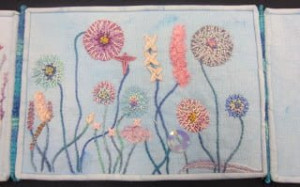
This first one is Running Stitch and French Knots. Frances finished each piece as a quilting square and then joined them to create a table runner.
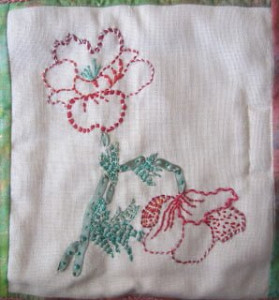
Running Stitch and French Knots

Running Stitch and French Knots

The Lilies are stitched with Chain Stitch and variations.
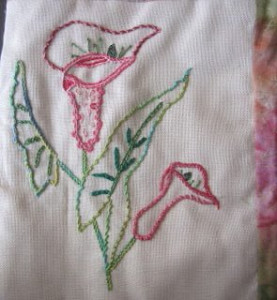
Chain Stitch Lilies

Chain Stitch Lilies

The Pansy is stitched with Stem Stitch and variations, Cross Stitch, Herringbone Stitch and Threaded Back Stitch.
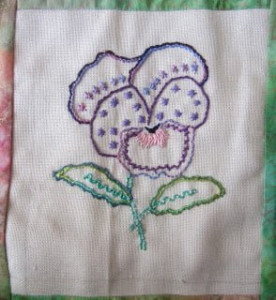
Stem Stitch Pansy

Stem Stitch Pansy

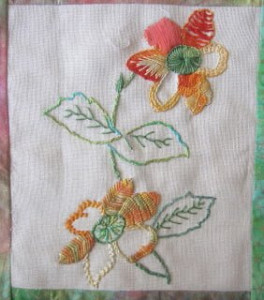
This last one is a Single Dahlia. The stitches are Buttonhole Stitch and variations, Cretan Stitch, Herringbone Stitch, Fly Stitch, Stem Stitch, Chain Stitch, Satin Stitch, Long and Short Stitch, Rumanian and other Leaf Stitches.
[do_widget id=arpw-widget-2]
Single Dahlia

Single Dahlia

The threads Frances used were DMC Coton a Broder and Clarks Anchor Floss with a few extras included as needed.
06/06/2013 by Ann Bernard

Accordion Book Stitched On Blue Linen

Judy Eckhardt was a member of our class in Guelph earlier this year. I have pleasure in sharing some of her work with you. Judy teaches machine embroidery and quilting but had not been using hand stitching creatively. This class was an opportunity for her to become acquainted with the huge variety of embroidery stitches.

All her pieces were stitched on fine handkerchief linen which she dyed herself. She used Treenway Silk threads wherever possible adding DMC Floss to add a needed colour. She made her pieces into an accordion book.

Blue is Judy’s favourite creative colour and, like Barbara Lee, she chose the challenge of working predominantly with blue on blue plus other colours in a congruent range of tones.

Chain Stitch and Variations plus Sorbello Stitch and Split Stitch

Chain Stitch, Sorbello Stitch and Split Stitch

Chain Stitch, Sorbello Stitch and Split Stitch

Cross Stitch, Stem Stitch, Outline Stitch and Turkey Work
You can see on this one how Judy finished her pieces and assembled them into a book.

Cross Stitch, Stem Stitch, Outline Stitch

Cross Stitch, Stem Stitch, Outline Stitch

Spider Wheels, Couching and Herringbone Stitch

Spider Wheels, Couching and Herringbone Stitch

Spider Wheels, Couching and Herringbone Stitch

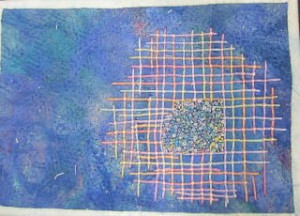
The back cover of the book features Trellis Work and French Knots

Trellis Work and French Knots

Trellis Work and French Knots

[do_widget id=arpw-widget-2]

To my surprise, Judy used no machine embroidery anywhere in this project.

19/05/2013 by Ann Bernard

Leaves to Love: Part 2

Hi. I’m Barbara Lee. Ann asked me to write up some notes for the next set of my leaves that she has posted. As a realist painter, I have wondered just how to render realistic images in thread using something other than long and short stitch. As I learned the different stitches and how they could be used, I was thrilled to discover I had lots of stitching options to choose from.

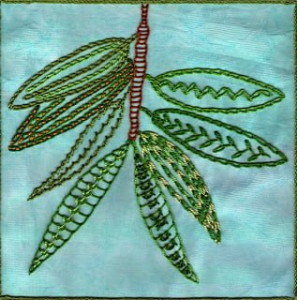
Black Willow uses a variety of chain stitches as well as sorbello. I used perle cotton on hand painted fabric. I drew the leaves on the fabric before stitching. However, due to the open nature of zigzag and feather chain, the penciled center vein shows on these leaves. Word to the wise: be careful where you put your lines on your fabric!

Black Willow

Black Willow

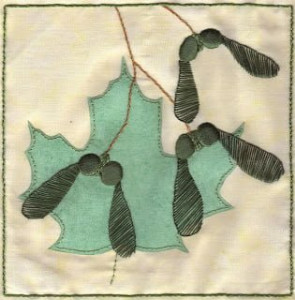
Sugar Maple combines fabric and stitch. The leaf itself was cut from hand painted fabric, ironed on with a 2-sided interfacing, and outlined with a running stitch. The wing portion of the maple seed is buttonhole stitch; the seed portion itself is padded satin stitch; and the two sides of the seed are joined with split stitch. Split stitch is also used in the branches and border.

Sugar Maple Leaves

Sugar Maple Leaves

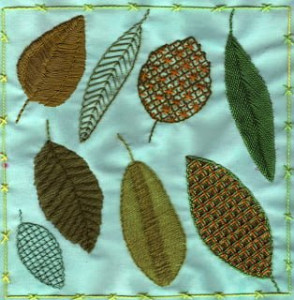
Leaf Collection is made up of a variety of different leaves stitched in various leaf and trellis stitches on hand painted fabric. Stitches include: laid work, fern stitch, fishbone, Roumanian couching, stem stitch, and trellis. The Battlement couching (the multi-coloured trellis leaf) was a lot of fun.

Leaf Collection

Leaf Collection

[do_widget id=arpw-widget-2]

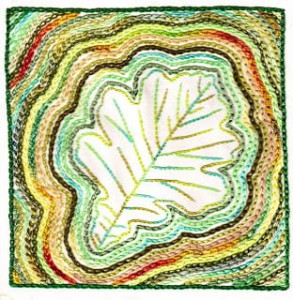
And, last but not least, my just completed piece, Chain Oak. I had a lot of fun with this piece. It’s plain chain stitch but I used a variety of different threads: DMC floss and perle cotton, crochet cotton, Persian yarn, Merino wool, and other wools in both solid and variegated colours. The different weights of the threads made for a very textural piece.

Chain Oak

Chain Oak

I had a lot of fun with this class. And I have many, many more leaves (and flowers and fish and…) that I would like to stitch using the different techniques I learned this past winter.

Thanks for a wonderful class, Ann!

05/05/2013 by Ann Bernard

Creative Use of Stitches: Part 4, completed

Completed Sampler

Completed Sampler

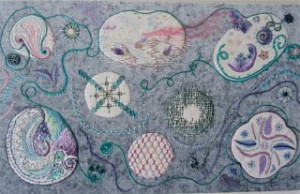
Here is the completed sampler. It is stretched onto a wooden frame and backed with white felt. A pocket for provenance papers is stitched onto the backing. The completed sampler is large, 31″ x 19 “, and that is big. Although I do not think it is beautiful, it does what was intended; it is a sampler of the basic stitches of embroidery and their variations. I will put it away for six months and my eyes will then see it fresh and objectivity becomes possible.
The background details were fun to conceive and stitch. They were essential to bring cohesion to these wildly different siblings.

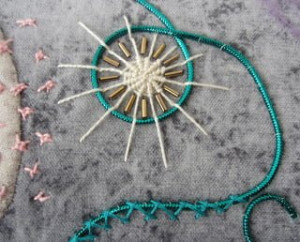
Here is a Whipped Spider Wheel. The spokes were lengthened with Straight Stitches which also held the cording in place. Then add some beads.

Whipped Spider Wheel

Whipped Spider Wheel

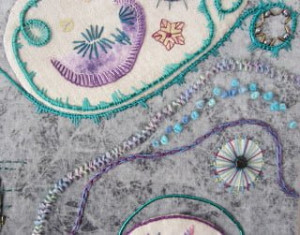
Cabled Stem Stitch

Cabled Stem Stitch

Cabled Stem Stitch: I like it better than Cable Chain.

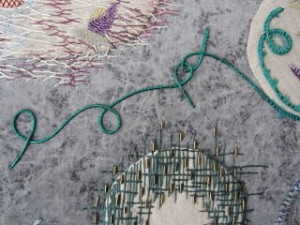
Lovers Knot

Lovers Knot

A Lovers’ Knot!

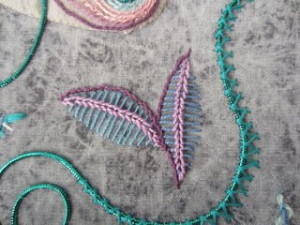
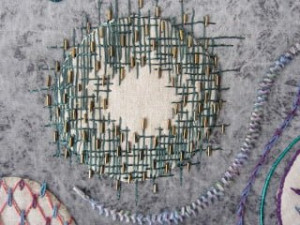
Coral Stitch and Chain Stitch

Coral Stitch and Chain Stitch

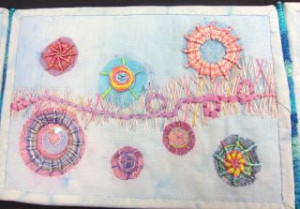
Single Coral Stitch and Chain Stitch, both with two threads in the needle. Coral Stitch is used to couch a circle of sampler fabric and then add some really large French Knots. That used up all of that wool or else I would have used it again elsewhere. It is also included in the Running Stitch sample.

[do_widget id=arpw-widget-2]

Whenever we are being creative, our imagination and ability take a step forward on the road to creativity. It is a road without end but, for all of us, it does have a sharply defined beginning. For a student working on a project such as this, all will create differently even though the stitches are the same. Their experience comes together with their taste, colour choice and available materials. The world of textile creation is a wonderful one with unending space for creation and with room for everyone no matter where they are on their journey. The next time I teach this project, it is inevitable that all the students, myself included, will produce a totally different creation than anything produced now.

I hope you have enjoyed visiting this project. Next, I will post samplers from my students.

And that, said Pooh, is that.

03/05/2013 by Ann Bernard

Creative Use of Stitches: Part 3

After Cross Stitch we moved on to Chain Stitch, another rigid example. I find that stitchers do not like stitching Squared Chain Stitch finding it difficult to manage the sequencing. I was determined to include it so they would have an example of it in their sample books.

Squared Chain Stitch

Squared Chain Stitch

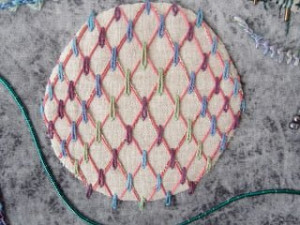
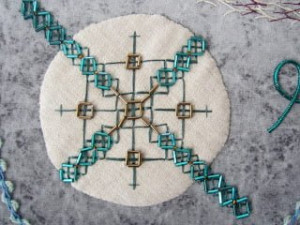
The next two small samples are of Trellis Work. A favourite in Jacobean stitching, it is fun to stitch and dramatic in its impact. I had designed and drafted the first one but had never tried it out in thread. It was a nuisance but interesting to stitch. The density of the darker threads made it look heavy but the scattering of beads lightened it up. I will certainly use this variation again.

The second Trellis Work was also an experiment. I added a thread of glitter to the framework lines and purposely used Detached Chain Stitch as I had not used it elsewhere. Notice that the diamonds and Chain Stitches become smaller towards the outside of the circle.

[do_widget id=arpw-widget-2]

All the stitchers had a work book. I asked them to bring a print of each of their samples for everyone in the class. On the reverse side of the print the relevant information was printed including the featured stitch, fabric, threads and the stitcher’s name and contact information. The simplest way to produce prints is to place the sampler face down on a scanner as you would to copy text. Place a medium heavy book on the wrong side of the fabric. Having obtained one satisfactory image, use it to print as many copies as you wish. In this way, all participants have a rich variety of ideas in their workbooks.

Trellis Work

Trellis Work

Detached Chain Stitch

Detached Chain Stitch

The final blog on this project will be about the stitches that connect and integrate these samplers.

30/04/2013 by Ann Bernard

Creative Use of Stitches: Part 2

This lesson featured Cretan Stitch and Buttonhole Stitch. For me, these two stitches did not blend well together and, next time, I will combine Cretan with the other leaf stitches.

Cretan Stitch

Cretan Stitch

Cretan is one of my all time favourite stitches. It can be so fluid and adaptable. Try listening to or singing the waltz ‘Die Fledermaus’ by Strauss to get the flowing and moving inspiration started. I have renamed this way of stitching it, the Cretan Waltz. The pink and mauve areas are silk rovings needle felted in position while the more solid mauve/purple areas are dyed dryer sheet. The bits of gold and copper are chocolate wrap.

Buttonhole Stitch is much more rigid. It can flow and move though I have not done that on this sampler. It does adapt well for couching. The coiled metallic cord is held in place with straight stitches.

[do_widget id=arpw-widget-2]

The third sampler in this edition is Cross Stitch with added beads. I used beads in small amounts here and there to add interest and some sparkle. The light mauve velvet background absorbed colour and did not give contrasts in texture or colour their due respect.

Buttonhole Stitch

Buttonhole Stitch

Cross Stitch

Cross Stitch

The next entry will feature Chain Stitch and Trellis Work.

30/03/2013 by Ann Bernard

Spring is a Promise

In the northern hemisphere, we are more than ready for spring this year. In Canada, we have had months of snow and cold but it has not been anything like as difficult as it has been in the United Kingdom. Right now, the snow drops are up but have been eaten by the rabbits. Aconites are just through the ground. Hyacinths have their noses up to sniff the air. They are still undecided.

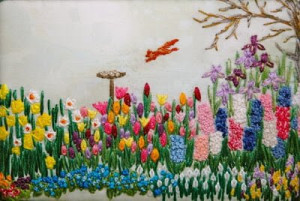
To encourage spring’s arrival, here is a spring garden project for you. Look at the garden carefully and see how many of the flowers you are able to recognize. Gardeners have an advantage with this.

Stitching Spring Flowers

Stitching Spring Flowers

Yes, here is a book that tells you how to stitch recognizable spring flowers. Published as an eBook, you can have it in your computer within minutes of reading this. If you are more comfortable with a printed copy, you can print it and put it in a binder. This is a convenient way to acquire it, it is inexpensive and you will be the owner of the first book on embroidery written and published electronically. As such it is a landmark though I expect there will be more embroidery books in the future. For the author especially, and for the publisher, it was a huge technical challenge.

[do_widget id=arpw-widget-2]

Stitching Idyllic: Spring Flowers uses only four basic stitches: Straight, Detached Chain, Buttonhole and French Knots. But these stitches have been adapted in new ways to achieve the results needed to portray recognizable plants and flowers. Written with a novice stitcher in mind, the section on preparation will tell you how to bond two layers of fabric to make one stable piece of fabric for the background. It explains how to mount the bonded fabric drum tight on a stretcher bars frame. Stranding and mixing thread colours to achieve the correct colour for each specific flower is included. There is also a simple way of planning the layout of your garden as not everyone feels comfortable drawing a design.

What more can you ask? Make this your Easter gift to yourself or for a friend. If I had not written it, I would be buying one for myself.

To see this book and browse the contents, go to annbernard.com. If you should then decide to purchase, the directions on how to do so are included.

Search

Recent Posts

  • Laid Work – Introduction.
  • How to stitch Snowdrops. Quick and Easy!
  • Inspirations, All Stitched Up! from Australia
  • Newsletter Märchenhaftes Sticken – Jessica Grimm
  • Cotton Quartet 1: Preliminaries & First Stitches

Recent Comments

  • Ann Bernard on Prepare your embroidery for the framers – Mount on Foam Core Board
  • SGibau on Prepare your embroidery for the framers – Mount on Foam Core Board
  • Louise Desmarais on Prepare your embroidery for the framers – Mount on Foam Core Board
  • Katherine & Malcolm Bell on Embroideries that Record History
    Queen Mary’s Carpet
  • Ann Bernard on Embroideries that Record History
    Queen Mary’s Carpet

Pretty Chic Theme By: Pretty Darn Cute Design